Key Points
- The median dental hygienist salary is $98,100 a year, or $47.16 an hour (BLS, May 2025). The lowest 10% earn under $74,880 and the top 10% earn more than $126,050.
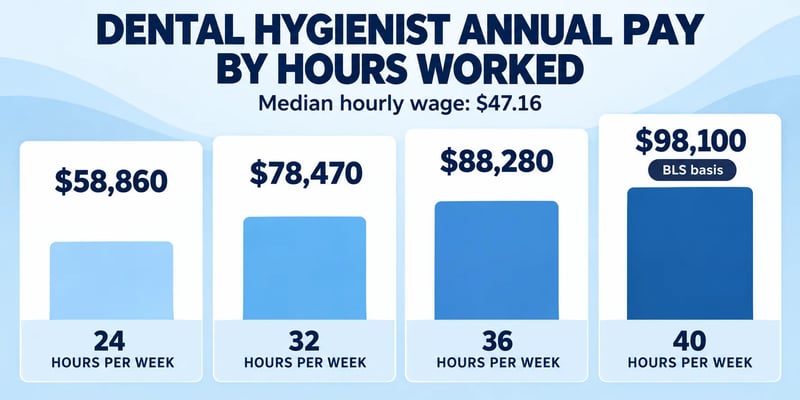
- BLS annual figures assume 2,080 hours. At the median rate, a four-day week pays $78,470 and a three-day week $58,860, in line with the $75,000 median income hygienists reported in DentalPost's 2026 survey.
- The District of Columbia pays the most, $65.97 an hour or $137,220 a year, and Alaska, Washington and California also top $60 an hour. Alabama pays the least at $29.41, or $61,160.
- Hourly hygienists are owed time and a half after 40 hours in a workweek under federal law, but only 5% of surveyed hygienists work more than 40 hours, and federal law adds nothing for evenings or weekends.
- Benefits often depend on hours. BLS notes they may be limited to full-time workers, and in March 2026 only 23% of part-time private-industry workers had access to employer medical coverage against 87% of full-time workers.
How Much Does a Dental Hygienist Make?
The median dental hygienist salary is $98,100 a year, or $47.16 an hour, according to the BLS Occupational Outlook Handbook for May 2025. The full range runs from $74,880 at the 10th percentile to $126,050 at the 90th, a $51,170 spread, and the hourly and annual versions of each step line up because BLS converts one to the other at 2,080 hours.
Setting changes little, because 94% of dental hygienists work in dentists' offices, where the median is $98,280. Physicians' offices pay a median of $91,160 and government employers, excluding state and local schools and hospitals, $80,830. Demand is steady: hygienists held 225,300 jobs in 2025, BLS projects 8% growth through 2035, and about 15,000 openings a year are expected as hygienists retire or change careers.
Dental Hygienist Hourly Wage
The median dental hygienist hourly wage is $47.16, and half of all hygienists earn between $40.18 and $52.16 an hour in the BLS wage percentiles published through O*NET. Hourly is the native unit for this job: BLS publishes the wage by the hour, most job postings quote hourly rates, and hygienist surveys such as DentalPost's 2025 survey and GoTu's 2025 report collect pay by the hour, so an offer is easiest to judge in those terms.
Where you work moves the hourly figure by more than $35. The District of Columbia pays a median of $65.97 an hour, Alaska $63.79, Washington $63.06 and California $60.06, while Alabama pays $29.41, Mississippi $32.35 and West Virginia $35.50. The top metro medians run higher still: San Francisco-Oakland-Fremont pays $70.56 an hour, San Jose $67.30, Seattle $64.30, Portland, Oregon, $59.18 and Los Angeles $59.12.
Job postings can quote more than the median. In San Francisco, for example, Indeed lists an average of $74.41 an hour from about 200 posted salaries, and the temp marketplace Teero advertises an average of $90.07 for a shift. Those are asking rates for open positions and short-notice shifts in one of the highest-cost metros, while the BLS figure is what employers report paying every hygienist on staff. Read a posting as the top of the local range, not the typical rate.
How the rate is structured matters almost as much as the number. Hourly pay is the most common arrangement, and the alternatives are a daily rate, a fixed salary, or commission on the production you generate. Trade guidance in RDH Magazine puts straight commission at 30% to 40% of daily production, and a hybrid model pays a base rate plus a percentage of production above a daily goal.
Commission can beat the hourly median in a busy practice, and it can fall below it when the schedule has holes, which is why a guaranteed base matters on a commission plan. For a benchmark, DentalPost's 2025 survey, fielded in late 2024, put the average hourly wage for full-time hygienists at $48.85 and the median at $47.
Dental Hygienist Annual Salary
A dental hygienist annual salary of $98,100 is a full-time-equivalent figure. The OEWS program that produces it states that "the OEWS annual wage estimates assume a full-time, year-round schedule of 2,080 hours," so the annual number is the hourly rate times 2,080 and nothing more. For a job where part-time schedules are normal, that assumption is the whole story. The table below converts the BLS hourly percentiles to annual pay at the schedules hygienists report working, rounded to the nearest $10, with the 40-hour row showing the published BLS annual figures.
At the median rate, a full-time hygienist earns about $1,886 a week and $8,174 a month before taxes. Two other measures confirm that the typical annual total sits below $98,100. BLS's household survey, which counts only full-time workers of 35 hours or more, puts the median weekly earnings of dental hygienists at $1,496 for 2025, about $77,800 a year. DentalPost's 2026 survey, which includes part-time hygienists, reported a median income of $75,000 and an average of $72,000, with the largest group (17%) earning $70,000 to $80,000.
None of that makes the $98,100 figure wrong. It means the annual salary a hygienist takes home is the hourly rate times the hours they choose or can get, and the sections on schedules and contract work below show how wide that choice runs.
Dental Hygienist Salary by State
The dental hygienist salary by state ranges from $137,220 in the District of Columbia to $61,160 in Alabama, a $76,060 gap for the same job. Fifteen states and the District of Columbia pay a median above $100,000, led by Alaska ($132,690), Washington ($131,160), California ($124,930) and Oregon ($122,080). Kentucky ($78,830), West Virginia ($73,840), Mississippi ($67,280) and Alabama are the only states under $80,000.
The largest employers are spread across the table. California has the most hygienist jobs (24,500) and the fourth-highest median, New York (13,660 jobs) pays $106,130, and Florida (11,980 jobs) pays $91,980. Texas (16,380 jobs) pays a median of $99,240, or $47.71 an hour, and our guide to how much dental hygienists make in Texas breaks that figure down by city and schedule.
Cost of living trims the top of the table and reshuffles the middle, though Alaska, DC and Washington still lead and Alabama, Mississippi and West Virginia still trail. On the Bureau of Economic Analysis 2024 regional price parities, California's prices run about 11% above the national average, which brings its $124,930 median down to roughly $112,800 in national-average dollars, while Alaska's $132,690 is worth about $129,600 and Texas's $99,240 rises to about $102,200 because its prices sit below average. Oklahoma, 22nd on the raw table, moves into the top 10 once its low prices are counted.
Overtime and Shift Differentials
Overtime for dental hygienists follows the federal Fair Labor Standards Act. The U.S. Department of Labor requires that non-exempt employees receive "overtime pay for hours worked over 40 in a workweek at a rate not less than time and one-half their regular rates of pay." A hygienist paid by the hour is generally non-exempt, because the professional exemption requires pay on a salary or fee basis of at least $684 a week, so a $47.16 hygienist who works a 44-hour week is owed $70.74 for each of the four extra hours.
Actual overtime is rare in hygiene. Only 5% of hygienists in DentalPost's survey work more than 40 hours a week, and the hygienist who works for more than one dentist, a pattern BLS describes, does not accrue overtime by combining the two. Overtime is counted per employer's workweek, so 24 hours at one practice and 24 at an unrelated practice is straight time at both. Three other rules are worth knowing:
- Daily overtime in California. The state's overtime law pays time and a half for hours beyond eight in a workday and double time beyond 12, so a 10-hour day triggers overtime even in a 30-hour week unless the office has a properly adopted alternative workweek schedule.
- Bonuses raise the overtime rate. DOL's Fact Sheet 56C explains that nondiscretionary bonuses, which include production bonuses tied to a target, are included in the regular rate of pay, so a hygienist on base pay plus production earns overtime on the bonus as well.
- Federal law adds nothing for evenings or weekends. DOL states that the FLSA "does not require overtime pay for work on Saturdays, Sundays, holidays, or regular days of rest, unless overtime is worked on such days."
That leaves shift differentials to the employer, and dental office postings rarely spell one out. Community health centers are the clearest exception. Marin Community Clinics in California, for instance, posts a registered dental hygienist role at $124,800 to $135,200 a year in which "evening and weekend shifts (4 hours) with direct patient contact, include a 10% pay differential in addition to your regular pay."
In the private practice postings we reviewed, Saturday coverage shows up as a separate Saturday-only position with its own hourly rate rather than as a percentage added to a weekday wage. Federal General Schedule jobs are one place where differentials are fixed by rule: night pay adds 10% for regularly scheduled work between 6 p.m. and 6 a.m., and regularly scheduled Sunday work carries a 25% premium.
If an offer involves evenings or Saturdays, ask whether the rate is a differential on your base or a flat premium rate, and get it in writing, because nothing in federal law puts it there for you.
Benefits and Bonuses
BLS says benefits for dental hygienists, "such as vacation, sick leave, and retirement contributions," vary by employer and "may be available only to full-time workers." That second clause is the one to plan around, because about a third of surveyed hygienists work part time. Across all private-industry workers in March 2026, BLS's employee benefits survey found a wide gap by schedule:
Those are economy-wide figures. Among hygienists, DentalPost's 2026 survey found 70% received paid vacation, 67% paid holidays and 62% dental coverage. Among hygienists with some benefits, the ones most often wanted but lacking were medical coverage (30%), paid continuing education (21%) and retirement benefits (20%). The full report adds that one in 10 hygienists receives no benefits at all and only one in four has every benefit they want.
Benefits are worth real money, which is why a job with coverage can beat a higher hourly rate without it. In BLS's Employer Costs for Employee Compensation data for June 2026, benefits made up 29.6% of what employers in health care and social assistance spent per hour worked: paid leave 8.3%, insurance 7.7%, legally required benefits such as Social Security and unemployment insurance 6.9%, supplemental pay 3.8% and retirement 3.0%. If benefits add even 10% to the value of a $50 wage, that package matches a $55 offer with none.
Bonuses are the least predictable layer. The common models are a percentage of production above a daily or monthly goal and a straight commission in place of an hourly wage, with trade guidance treating roughly a third of hygiene production as the benchmark for hygienist pay.
Most surveyed hygienists do not see any of it: in a 2025 survey of 2,087 hygienists by the staffing platform GoTu, 66% received no monetary bonus and 44% had gone two years without a raise.
Raises themselves are modest. DentalPost's 2026 survey found 73% of hygienists had received a raise within the past two years and 46% within the past 12 months, while 7% had never received one, and a 2022 survey of 5,122 hygienists run by the ADA Health Policy Institute with the American Dental Hygienists' Association put most raises at 1% to 3%. The ADA's third-quarter 2026 report adds the context: hourly earnings of dental office staff, a group that includes hygienists, rose 21% since January 2021, against 27% inflation over the same period.
Full-Time vs. Part-Time vs. Contract
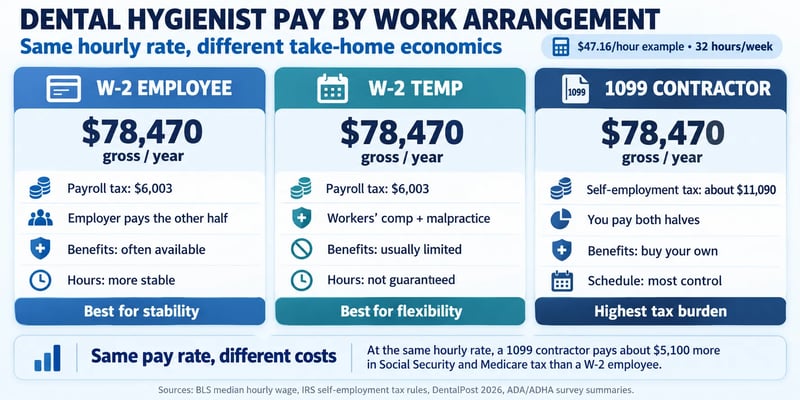
The same hourly rate produces three very different incomes depending on the employment arrangement behind it.
Full-time employees. In DentalPost's 2026 survey, 65% of hygienists reported full-time status and 56% worked 32 to 40 hours, with nearly half on a four-day week. Full-time status is what unlocks the benefits above, and it is the arrangement the BLS annual figure describes.
Part-time employees. Among surveyed hygienists, 35% work part time, 39% work fewer than 32 hours, and the 2022 ADA and ADHA survey, using the same 32-hour line, found 28.8%. BLS notes that "dentists may hire hygienists to work only a few days a week, so some hygienists work for more than one dentist." Stacking two part-time positions can reach full-time hours and pay, but each employer treats you as part time, so benefit eligibility and overtime are calculated separately at each.
Temp and contract hygienists. Temp marketplaces fill single shifts and short assignments. Teero lists average temp-shift rates of $97.00 an hour in Anchorage, $91.59 in Seattle and $90.07 in San Francisco against BLS metro medians of $63.82, $64.30 and $70.56 for employed hygienists. The premium pays for what the arrangement leaves out: usually no paid time off or employer benefits, no guaranteed hours, and the risk of a canceled day.
The platforms differ on the details. Teero and Kwikly treat temp hygienists as W-2 employees, with taxes withheld, workers' compensation and malpractice coverage on every shift. GoTu runs both 1099 and W-2 shifts and pays 100% of the day's pay when an office cancels within 24 hours. Cloud Dentistry pays hygienists as 1099 contractors, usually with the office paying directly, unless the hygienist sets a W-2-only profile, and its turn-away policy covers half the booked day up to four hours when a shift is canceled at the last minute or on arrival.
Working as a 1099 contractor changes the math further. The IRS applies a common-law test that weighs behavioral control, financial control and the type of relationship to decide whether a worker is an employee, and a hygienist who works the office's schedule with its equipment under its direction usually looks like an employee under that test.
A contractor pays both halves of Social Security and Medicare through self-employment tax, 12.4% plus 2.9% on 92.35% of net earnings, with half of that tax deductible, and has no right to FLSA overtime or employer benefits.
California goes further: under the state's ABC test, a worker is presumed to be an employee unless the hiring entity proves all three prongs, including that the work is outside its usual course of business. The Labor Code (section 2783) exempts dentists from that test but not dental hygienists, which is why the California Dental Association advises practices to classify hygienists and temporary workers as employees rather than 1099 contractors.
The arithmetic at the median rate shows the trade. A hygienist employed 32 hours a week at $47.16 grosses $78,470 a year and pays $6,003 in Social Security and Medicare tax, with the employer paying the other half. The same $78,470 earned as a 1099 contractor carries about $11,090 in self-employment tax, roughly $5,100 more, before the cost of health coverage and lost paid leave, so a contract rate needs to run well above the employee rate to come out ahead.
The hiring market gives hygienists room to ask for that: the ADA Health Policy Institute reported in April 2026 that only 60% of dentists had enough hygienists on staff and that 91% of those recruiting called it very or extremely challenging.